
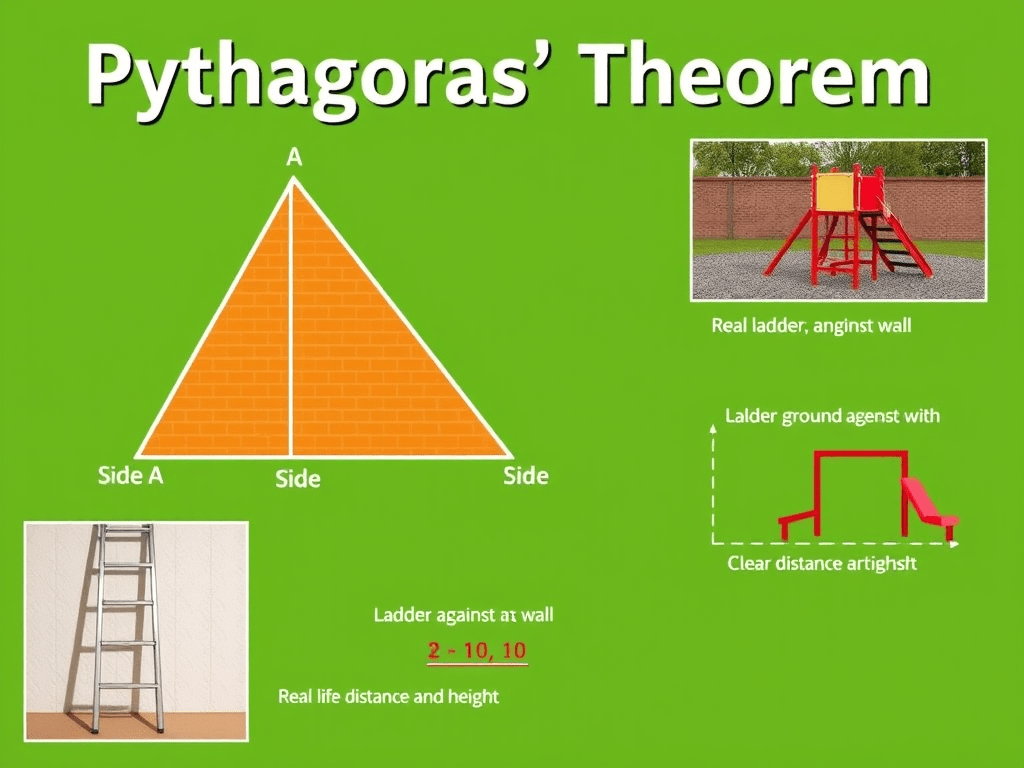
📐 What is Pythagoras’ Theorem?
Pythagoras’ Theorem is a math rule used for right-angled triangles
(a triangle with one 90° corner).
🧠 The rule says:
(Side A)² + (Side B)² = (Longest Side)²
The longest side is called the hypotenuse.
🔺 Easy picture idea (imagine)
      |\
   b  | \  c  ← longest side
      |__\
        a
🏡 Real-life examples kids can understand
1️⃣ Ladder against a wall 🪜
- Wall height = 6 m
- Ground distance = 8 m
- How long is the ladder?
Use Pythagoras:
6² + 8² = c²
36 + 64 = 100
c = 10 m
👉 The ladder must be 10 meters long.
2️⃣ Walking across a playground 🛝
You can:
- Walk 20 m east
- Then 15 m north
Instead of walking both sides, you can go straight across.
20² + 15² = 400 + 225 = 625
√625 = 25 m
👉 Straight path = 25 meters.
3️⃣ TV screen size 📺
TV size is measured corner to corner.
If a TV is:
- 48 cm wide
- 36 cm tall
48² + 36² = 2304 + 1296 = 3600
√3600 = 60 cm
👉 TV size = 60 cm.
4️⃣ Baseball throw ⚾
A ball is thrown:
- 30 m forward
- 40 m to the side
How far did it really go?
30² + 40² = 900 + 1600 = 2500
√2500 = 50 m
👉 The ball traveled 50 meters.
🧠 When can we use Pythagoras?
✔ Only for right-angled triangles
✔ When you know two sides and want the third
🌟 Fun facts for kids
- Discovered over 2,000 years ago
- Used by builders, gamers, map makers, engineers
- Helps GPS and video games measure distance
🎯 Easy way to remember
Square the two short sides
Add them
Take the square root
 Beyond Science
Leave a comment