
🦖 How do scientists guess the age of dinosaurs?
🦴 Step 1: Finding dinosaur fossils
- Dinosaurs lived millions of years ago
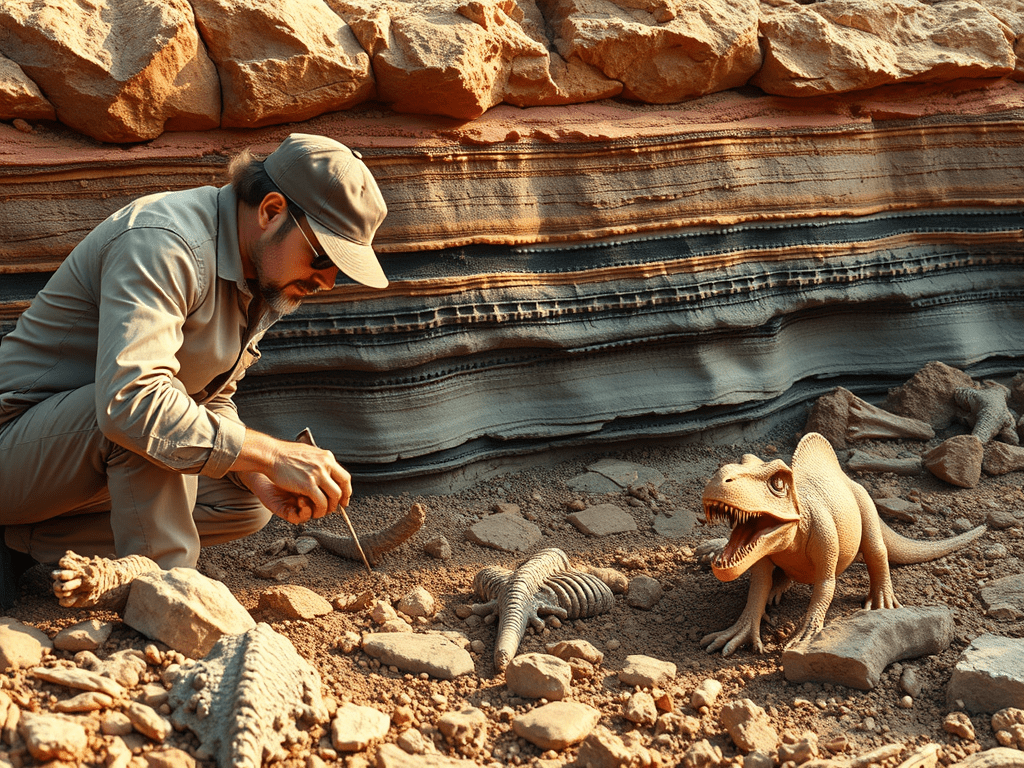
- Scientists find their bones, teeth, or footprints as fossils
- Fossils are found inside rocks
🧠 Bones themselves don’t have dates — rocks help tell the age
🪨 Step 2: Looking at rock layers
Earth has layers of rock like a layered cake 🍰
- Top layers → younger
- Bottom layers → older
If a dinosaur fossil is found:
- Deep layer = very old dinosaur
⏳ Step 3: Radiometric dating (science clock)
Some rocks have tiny radioactive atoms.
These atoms:
- Change very slowly over time
- Work like a natural clock
Scientists measure how much has changed to know:
👉 How old the rock is
🧠 This can tell ages like 65 million years old
🧪 Step 4: Volcanic ash clues
- Dinosaur fossils are often near volcanic ash layers
- Ash can be dated very accurately
- Fossil age = age of the ash nearby
📅 Step 5: Dinosaur era clues
Dinosaurs lived in:
- Triassic
- Jurassic
- Cretaceous
Each period has special rocks and fossils that help scientists guess the age.
🧠 Easy way to remember
Scientists don’t date the dinosaur — they date the rock
🌟 Fun facts for kids
- Dinosaurs lived from 230 to 66 million years ago
- Humans never met dinosaurs ❌
- A T-rex lived about 68 million years ago
🧒 Simple example
Imagine finding a toy buried under:
- 10 layers of sand → older
- 2 layers of sand → newer
Same idea with fossils!
📌 One-line summary
Scientists guess dinosaur age by studying rock layers and using natural atomic clocks.
 Beyond Science
Leave a comment