
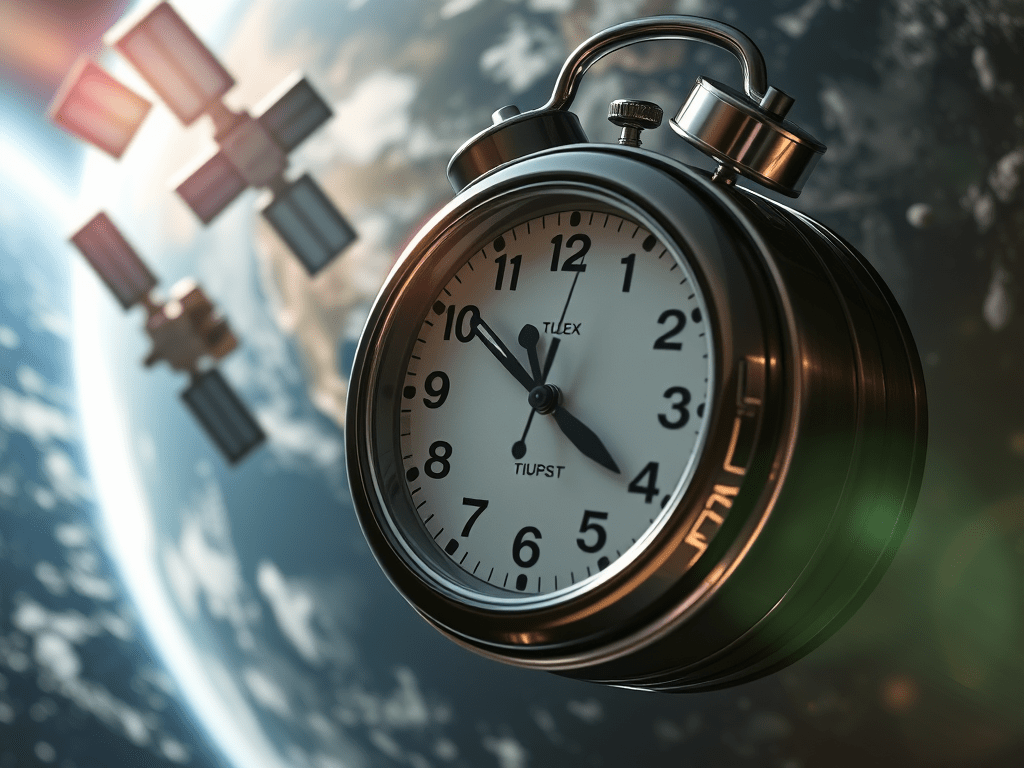
Atomic clocks do act differently in space, and that’s how scientists proved time dilation.
⏳ What is time dilation?
Time dilation means time can pass at different speeds depending on:
- Speed (moving very fast)
- Gravity (being near a big object like Earth)
This idea comes from Albert Einstein.
⚛️ Do atomic clocks work differently in space?
👉 The clocks work the same, but time itself changes.
Atomic clocks are so accurate that they can detect tiny changes in time.
🚀 1. Time dilation because of SPEED (Special Relativity)
- Astronauts and satellites move very fast
- Fast motion makes time run slower
🧠 So a clock on a fast satellite ticks slightly slower than one on Earth.
🌍 2. Time dilation because of GRAVITY (General Relativity)
- Earth has strong gravity
- Space has weaker gravity
👉 Weaker gravity makes time run faster
So a clock in space ticks faster than one on Earth.
⚖️ What happens to satellite clocks?
Satellites feel both effects:
- Speed → time slows down ⏪
- Less gravity → time speeds up ⏩
📌 Final result:
Satellite clocks run slightly faster than Earth clocks
🧪 How did scientists prove this?
🔬 Famous experiment (1971)
- Atomic clocks were flown on airplanes ✈️
- Other clocks stayed on Earth
- When compared:
- Flying clocks showed tiny time differences
✔️ Exactly as Einstein predicted!
📡 Why is this important?
GPS needs time dilation!
- GPS satellites use atomic clocks
- If time dilation corrections were ignored:
- GPS would be wrong by kilometers each day
📍 Thanks to Einstein, GPS works perfectly!
🧠 Easy way to remember
Fast speed slows time
Weak gravity speeds time
🌟 Fun facts for kids
- Astronauts age tiny bit slower than people on Earth
- Atomic clocks can measure differences of billionths of a second
- Einstein’s ideas are used every day in phones 📱
📌 One-line summary
Atomic clocks show that time runs at different speeds in space due to speed and gravity, proving Einstein’s time dilation.
 Beyond Science
Leave a comment