
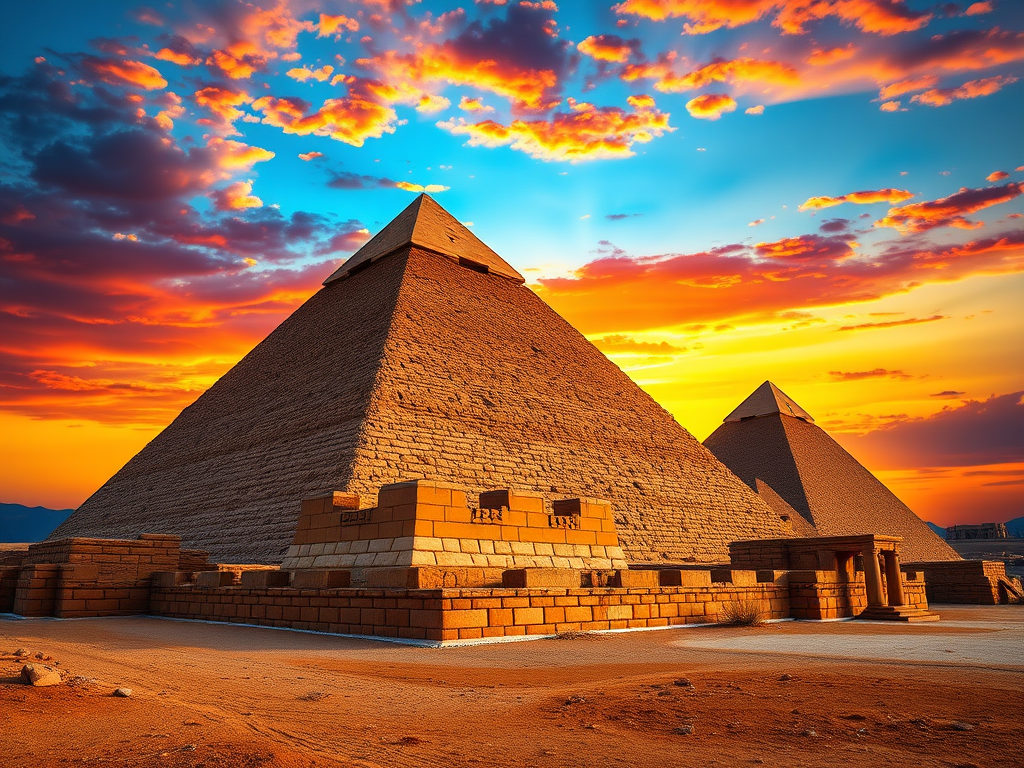
🔺 Pyramids & the Science Behind Their Shape
🏗️ What is a pyramid?
A pyramid is a structure with:
- A wide base
- Sloping sides
- A pointed top
The most famous pyramids are in Egypt, built over 4,500 years ago.
🧠 Why did ancient people choose the pyramid shape?
1️⃣ Super strong shape 💪
- The wide base spreads weight evenly
- Sloping sides push weight downward, not outward
- This makes pyramids very stable
👉 That’s why pyramids can stand for thousands of years!
2️⃣ Earthquake-resistant 🌍
- During shaking, force moves down the slopes
- Less chance of collapse compared to tall straight walls
3️⃣ Easy to build taller 🧱
- As the pyramid goes up, it gets lighter
- Smaller stones are needed near the top
📐 Science of angles
- Pyramid sides are built at a careful angle
- Not too steep → won’t fall
- Not too flat → won’t slide
Ancient builders used math and geometry 📏
☀️ Science & astronomy
- The Great Pyramid is aligned with:
- North, South, East, West
- This shows knowledge of:
- Stars ⭐
- Sun ☀️
- Earth’s directions 🧭
🌡️ Temperature control
- Inside pyramids:
- Cool during day
- Warm at night
- Thick stone walls act as natural insulation
🪨 Materials science
- Made from limestone and granite
- Heavy stones placed with precision
- Used ramps, levers, and teamwork
❌ Pyramid myths (clarified)
- ❌ No magical power beams
- ❌ No aliens
- ✔️ Built by skilled human engineers
🧠 Easy way to remember
Pyramids are strong because their shape spreads weight downward
🌟 Fun facts for kids
- The Great Pyramid was the tallest building for 3,800 years!
- Each stone weighs as much as a car 🚗
- Pyramids are one of the 7 Wonders of the Ancient World
📌 One-line summary
Pyramids are strong, stable structures built using smart geometry, physics, and engineering.
 Beyond Science
Leave a comment