
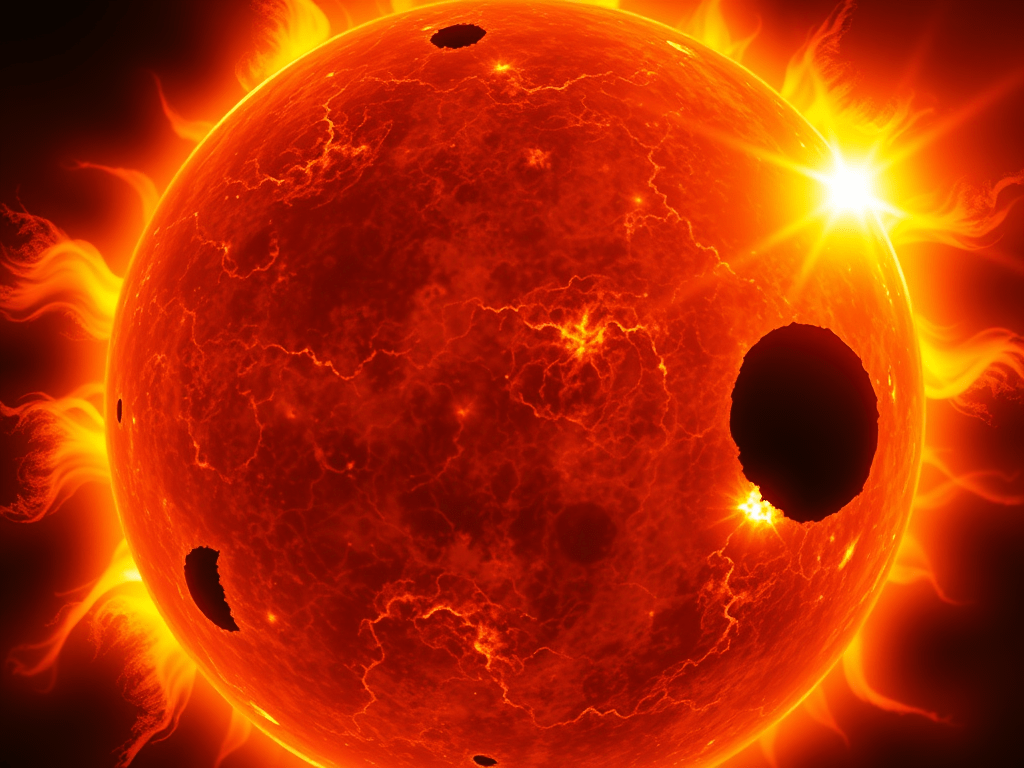
☀️ What Are Sunspots?
🔵 What is a sunspot?
A sunspot is a dark-looking spot on the surface of the Sun.
👉 They look dark, but they are not holes and not cold!
🌡️ Why do sunspots look dark?
- Sunspots are cooler than the rest of the Sun
- Normal Sun surface: about 5,500°C
- Sunspots: about 3,500–4,000°C
Because they are cooler, they look darker ☁️
🧲 What causes sunspots?
Sunspots are caused by strong magnetic fields.
- The Sun has a powerful magnetic field 🧲
- Sometimes the magnetic field gets twisted
- This stops hot gas from coming up
- That area becomes cooler → sunspot forms
🔄 Do sunspots stay forever?
No ❌
- Sunspots can last from a few days to many weeks
- They appear and disappear over time
🔁 Sunspot cycle
Sunspots follow a cycle of about 11 years:
- Few sunspots → quiet Sun
- Many sunspots → active Sun
This is called the solar cycle 🔄
⚡ Why are sunspots important?
More sunspots means:
- More solar flares
- Stronger solar storms
- Beautiful auroras on Earth 🌈
Too many solar storms can affect:
- Satellites 🛰️
- Power lines ⚡
- Radio signals 📻
🌟 Fun facts for kids
- Sunspots are bigger than Earth 🌍
- You must never look at the Sun directly
- Scientists study sunspots to predict space weather
🧠 Easy way to remember
Sunspots are cooler, dark areas on the Sun caused by strong magnetic fields
📌 One-line summary
Sunspots are dark spots on the Sun where strong magnetic fields make the surface cooler.
 Beyond Science
Leave a comment